
Process or equipment downtime for corrosion or unknown material in the system is a big cause for concern, but it is often vital in these cases to identify the root causes and correct it before the problem expands in scope. So, if you notice a deposit or scale forming in your process lines or piping, collecting in the bottom of a pump or valve, or in the worst case, appearing as a contaminant in your product, fixing the conditions that are causing these unwelcome materials can be an important task. In order to fix the causes, you first need to identify the unknown material so you know what is corroding, breaking down, precipitating, or forming in your system as you can only then make the proper changes to solve the problem.
At a base level, your identification of an unknown material can really happen on two fronts, phase identification and elemental identification, information which H&M is well equipped to help you through the use of techniques like XRD, XRF, and SEM/EDS. In many cases, the best and most complete picture of your issue comes from having both pieces of information. The study below helps demonstrate the information each test can give and how combining them can help in many situations.
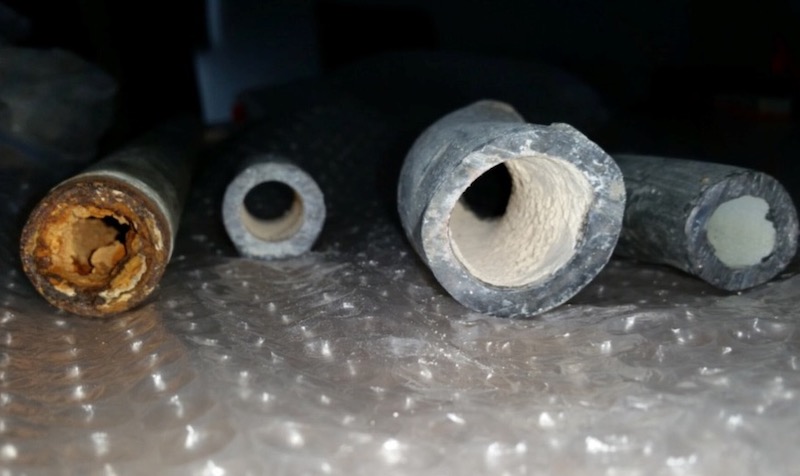
In these two studies below unknown samples were collected from a filter within a process flow, and in the other it was a corrosion product / scale from the side of a pipe. The customers involved wanted to start with XRF testing which would reveal the elements present. Generally, If you can scrape or gather enough material to prepare a reasonable sample by one of the preparation methods for XRF, the material can be evaluated and you would receive a report like the one shown below. For XRF, the elements present in amounts as low as 50 ppm are detected and reported as shown.
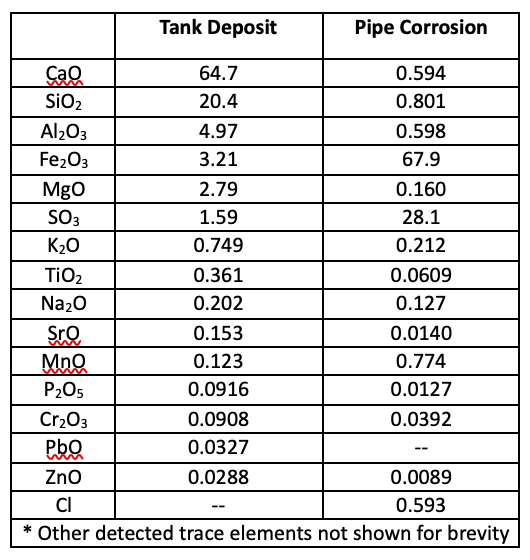
Table I: Semi-quantitative Chemical Analysis (wt. %)
As the customer, you could look at the information above and feel like you have an answer, but do you really know what you need to address your problem? Those common elements could indicate that someone might have dropped some cement powder into your system while doing plant maintenance, or you have precipitated a calcium oxide or calcium silicate phase, or have a mixture of common soil phases like quartz, calcite, and feldspars. Those elements in the first case could imply any of those. The elements on the right study could be rust as iron oxide and sulfur or any of the common Fe-S compounds or sulfates. These differences could matter in terms of understanding the reaction conditions or how to best treat the material to eliminate the issue.
With information on your process conditions you could make guesses on what has happened, but wouldn’t it be better to know exactly what phase you have? The elemental identification definitely has value to understanding minor and trace level phases when necessary and can be used to narrow down and supplement substitutional information (more below). But, knowing exactly what phase and structure you have can be useful in diagnosing the full problem.
That’s where XRD comes in as useful technique. By running a diffraction scan on the unknown material, you can identify the phases and crystal structures that are present. You can know that you have CaCO3 present and know that it is specifically the calcite form (Figure 1) and not aragonite, which is also CaCO3 (The two forms are shown in an additional scan of a different sample (Figure 2) to demonstrate how XRD can see their different structures while XRF does not.) Similarly, we know in the pipe corrosion that both Fe and S are high, but we cannot determine from the XRF how and if these two elements are related in their compound compositions, whereas from the XRD scan of the sample (Figure 3) shows us what specific compounds each of these elements belongs to and the approximate ratio of these compounds in the sample (Figure 4).
XRD is an incredibly powerful and versatile technique for identifying the phase and crystal structure details of both known and unknown phases as would apply here. For the identification of an unknown crystalline material it is one of the simplest and straightforward options. You do not need to know anything prior about the sample or conditions; the scan itself is matched to databases of known materials like a fingerprint and you can establish the identity and quantity of the phases present in even complicated and multiphasic samples like these shown.
In both portions of the study, the XRD scans were able to identify the phases present, which reveal further insight into the causes and issues at play. In the one case, it appears that typical “dirt” was getting into the process system and was collecting in the filter as the phases present are all typical geological phases that occur together in common soil types. In the corrosion scale sample, the phases present are very indicative of the kind of corrosion conditions (sweet versus sour corrosion) and can be useful in deciphering what may be occurring in the pipe.
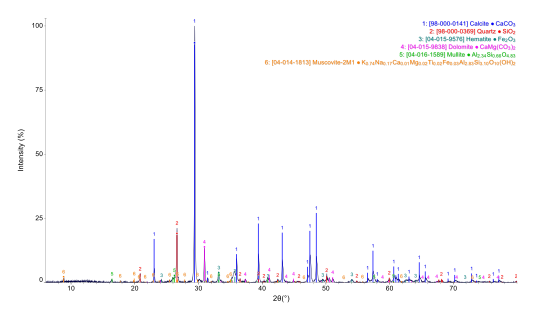
Figure 1 – XRD pattern for sample Tank Deposit with stick patterns showing the identified phases.
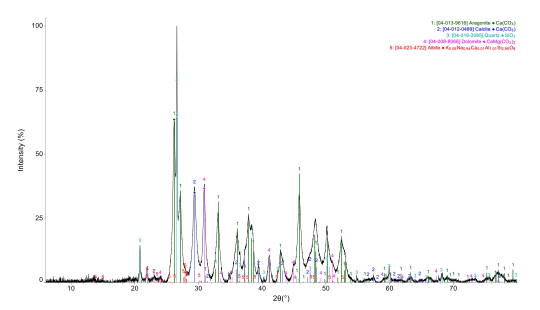
Figure 2 – XRD pattern for a sample with a mixture of primarily Calcite and Aragonite demonstrating the capabilities of the technique to differentiate and identify these two Ca(CO3) phases.
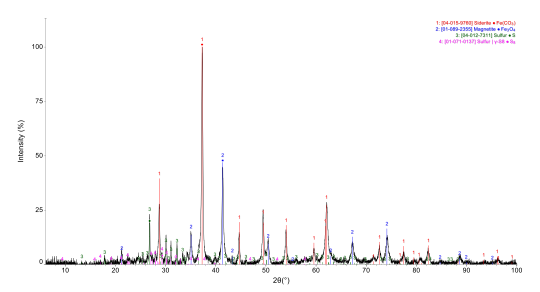
Figure 3 – XRD pattern for a sample Pipe Corrosion with stick patterns showing the identified phases.
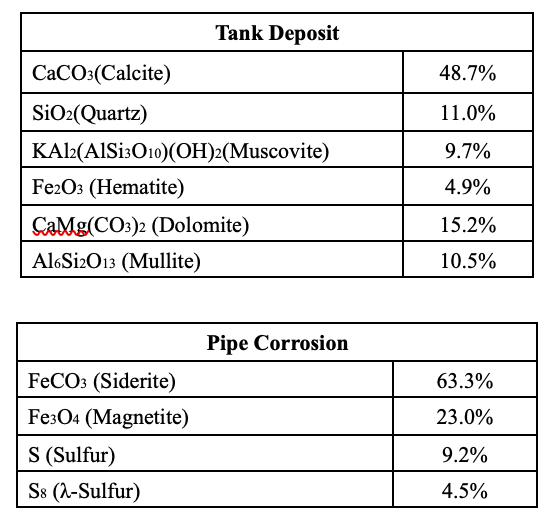
Figure 4 – Quantitative Crystalline Phase Analysis (wt. %).
For identifying unknown materials as mentioned, the combination of XRD and XRF can be exceptionally powerful in characterizing both the major phases, minor and trace level elements, and understanding more precisely the composition of substitutional or complicated phases.
You may notice that the compositions don’t quite “add up” in some cases and that is not unusual for this type of analysis. These two techniques have very different outputs, limitations, and benefits which are important to understand and appropriately interpret. The XRF results are a more precise representation of the over-all sample, but can’t accurately account for the different compounds present. XRD more definitively tells us what compounds are present, but cannot detect very small quantities, substitutional elements (such as some Mn being present in the Fe oxide phase), or non-crystalline substances. Together, you can better understand what is present when a phase can be rich in one element versus another or in cases where you see accelerated corrosion of an alloy with multiple elements, the combined information can really help understand the conditions leading to the specific corrosion products observed based on what element or phases are present versus missing. For many projects, these two techniques together would be the recommended starting point for a complete and thorough materials analysis.
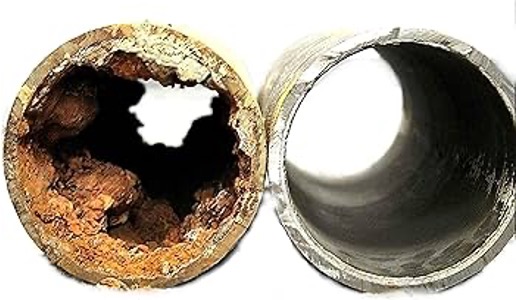
Another interesting option exists for cases where XRD and/or XRF aren’t feasible or simple. In cases where the amount of material is very, very small or difficult to prepare well because of size or adherence of other factors, a final option for identifying an unknown is to use the EDS analysis in an SEM to identify the elements present. As this technique utilizes the electron microscope and is local to a very small area of interest, you can have a single speck of material or the scale can still be attached to a surface and a quick analysis can be taken to identify the elements present in one spot versus another, i.e., you can see what is indicated for a small “greenish” corrosion pit or area versus the normal or secondarily colored area right nearby. You can also map specific elements using the raster of the beam in the SEM and show that elements are present or absent in specific regions.